


Abstract
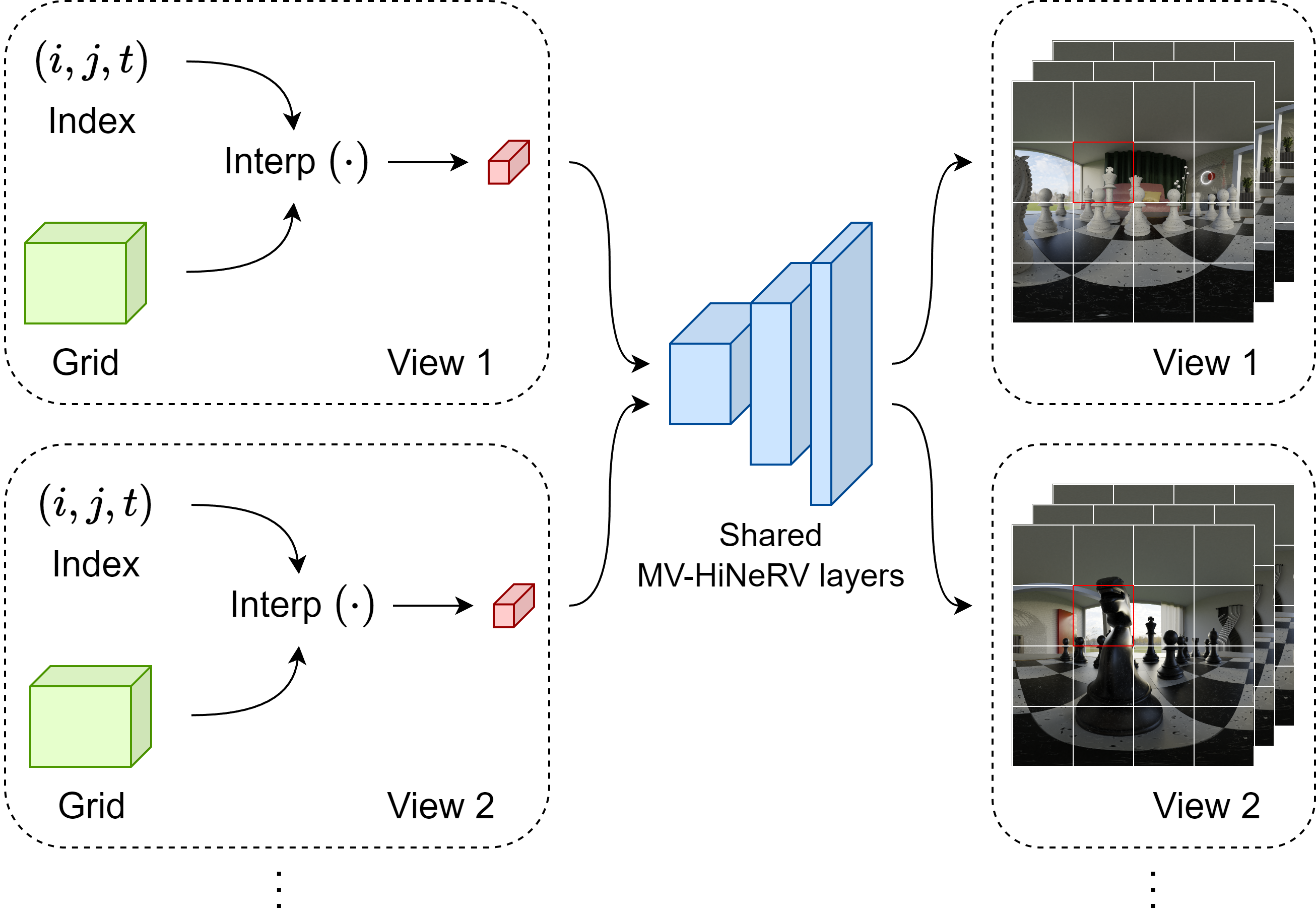
Recent work on implicit neural representations (INRs) has evidenced their potential for efficiently representing and encoding conventional video content. In this paper we, for the first time, extend their application to immersive (multi-view) videos, by proposing MV-HiNeRV, a new INR-based immersive video codec. MV-HiNeRV is an enhanced version of a state-of-the-art INR-based video codec, HiNeRV, which was developed for single-view video compression. We have modified the model to learn a different group of feature grids for each view, and share the learnt network parameters among all views. This enables the model to effectively exploit the spatio-temporal and the inter-view redundancy that exists within multi-view videos. The proposed codec was used to compress multi-view texture and depth video sequences in the MPEG Immersive Video (MIV) Common Test Conditions, and tested against the MIV Test model (TMIV) that uses the VVenC video codec. The results demonstrate the superior performance of MV-HiNeRV, with significant coding gains (up to 72.33%) over TMIV.
Results
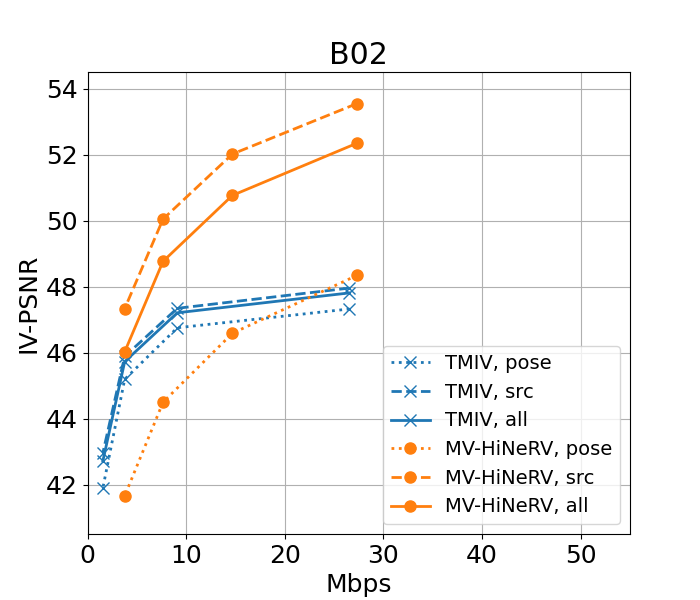
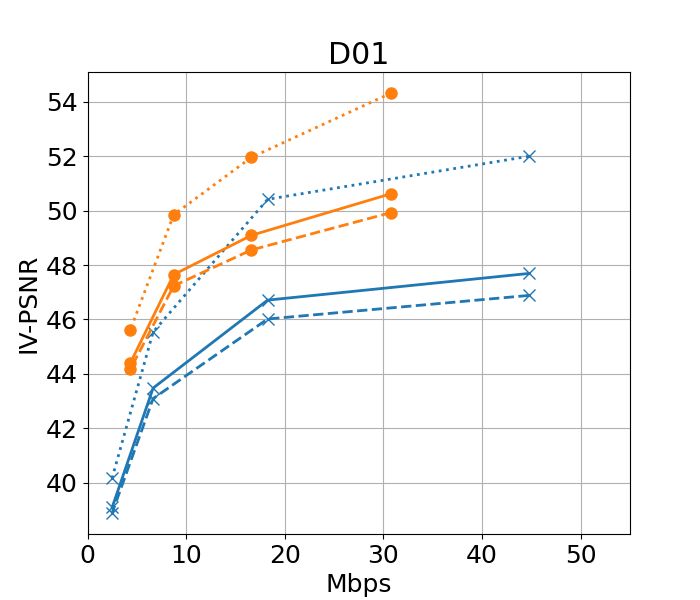
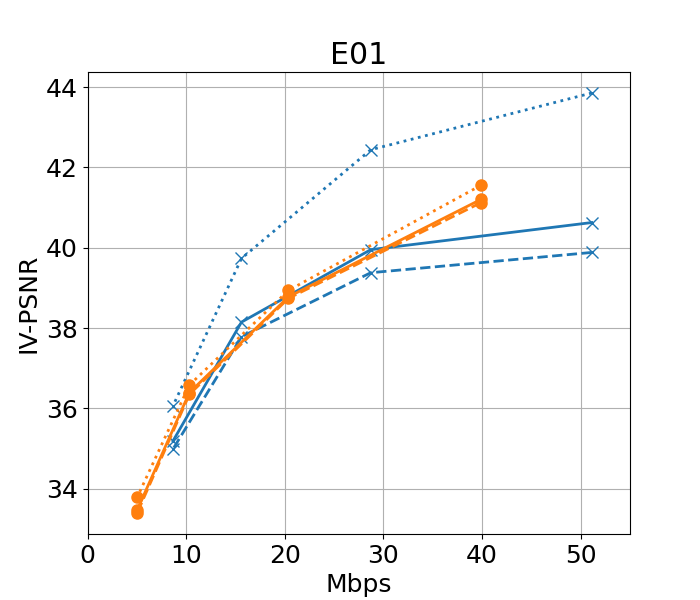
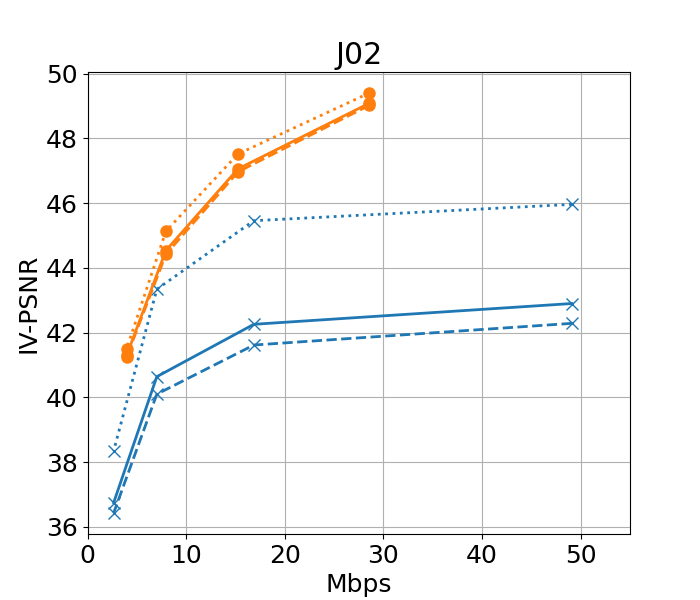
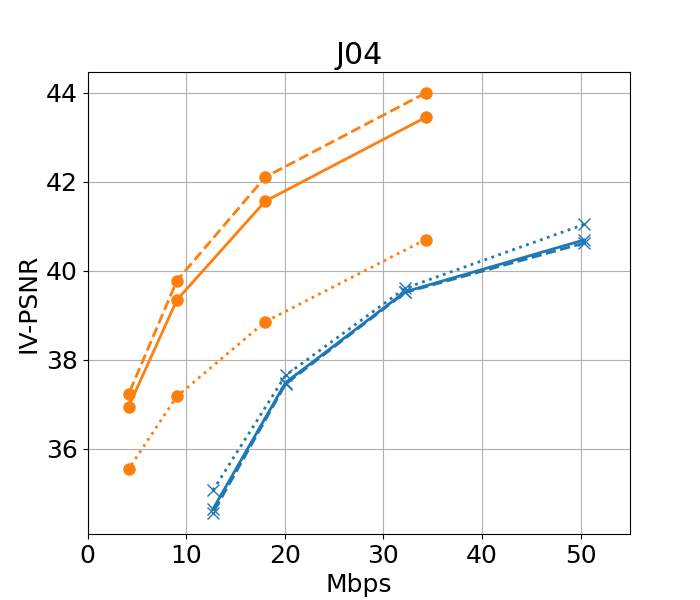
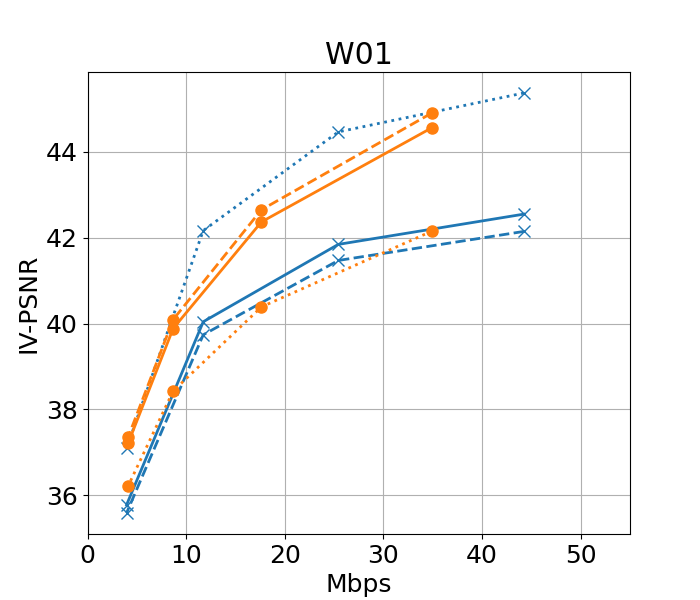
IV-PSNR results of TMIV and MV-HiNeRV on the MIV CTC sequences.
Qualitative Results
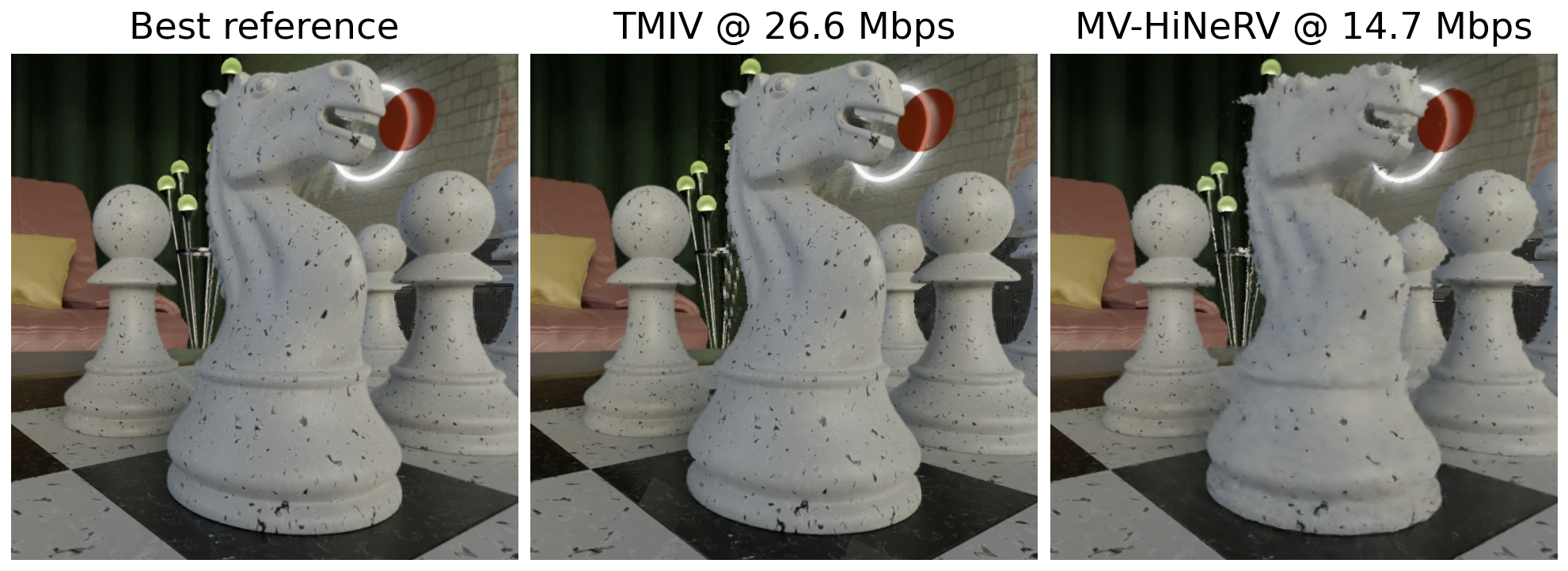
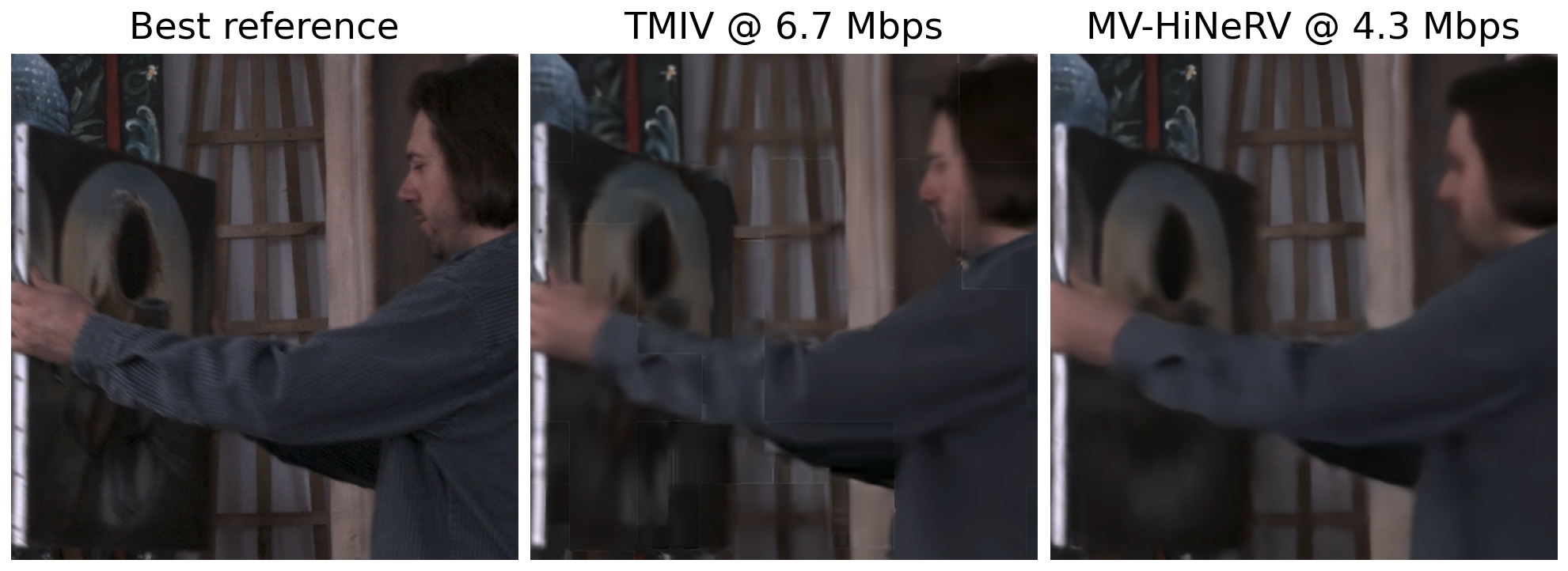
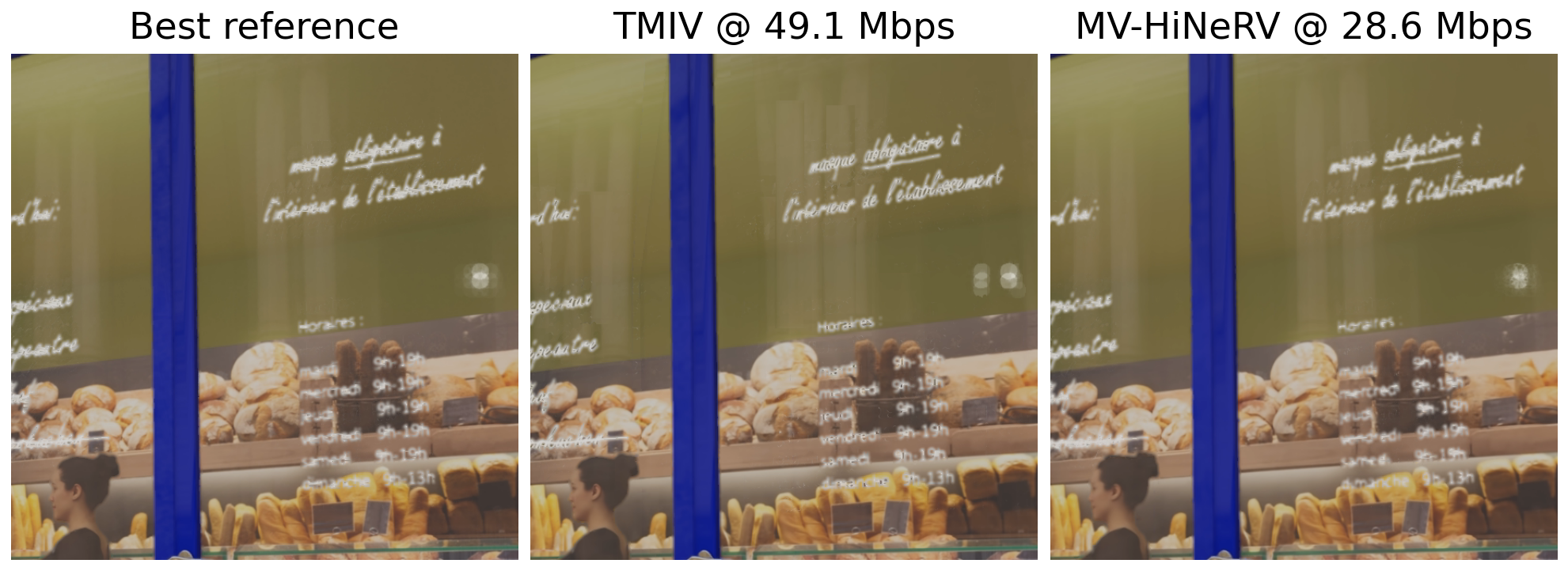
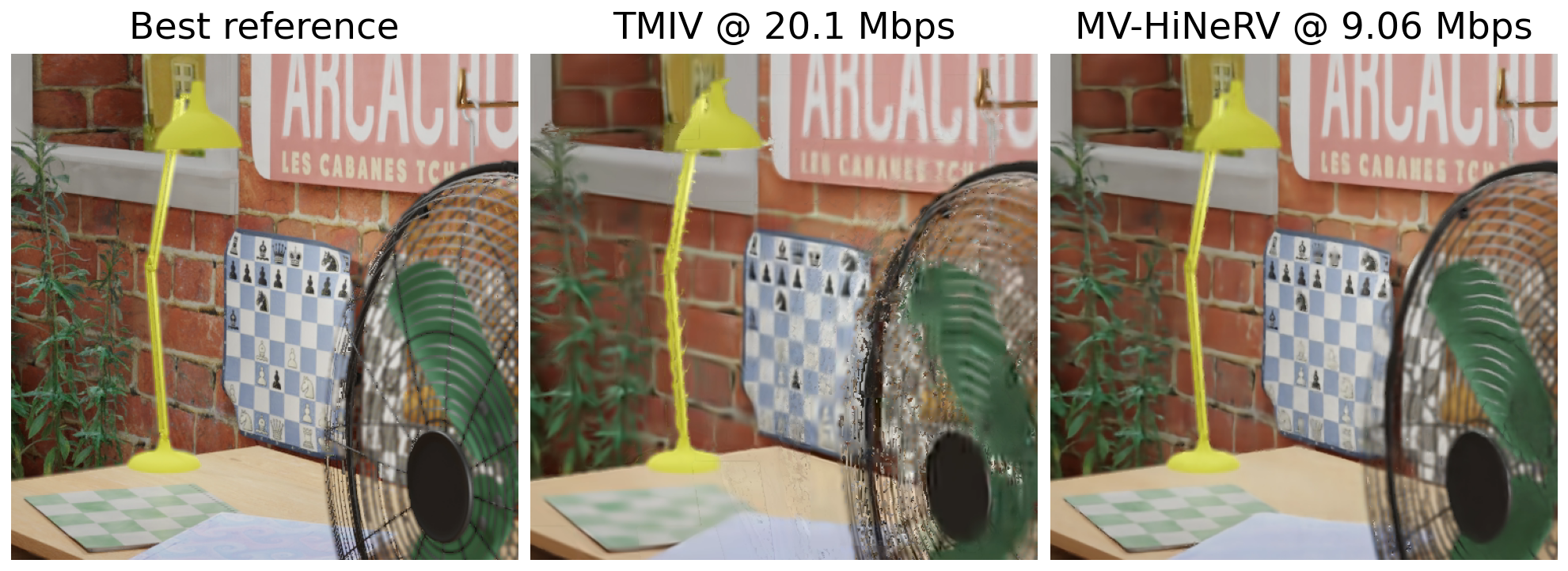
Visual comparison between the best reference, TMIV and MV-HiNeRV (bitrates as labelled).
Citation
@inproceedings{kwan2024immersive,
    title={Immersive Video Compression using Implicit Neural Representations},
    author={Ho Man Kwan and Fan Zhang and Andrew Gower and David Bull},
    booktitle={Picture Coding Symposium (PCS)},
    year={2024}
}